

Contents

Publications


Publications

Contents
Data the key to walking to work safely
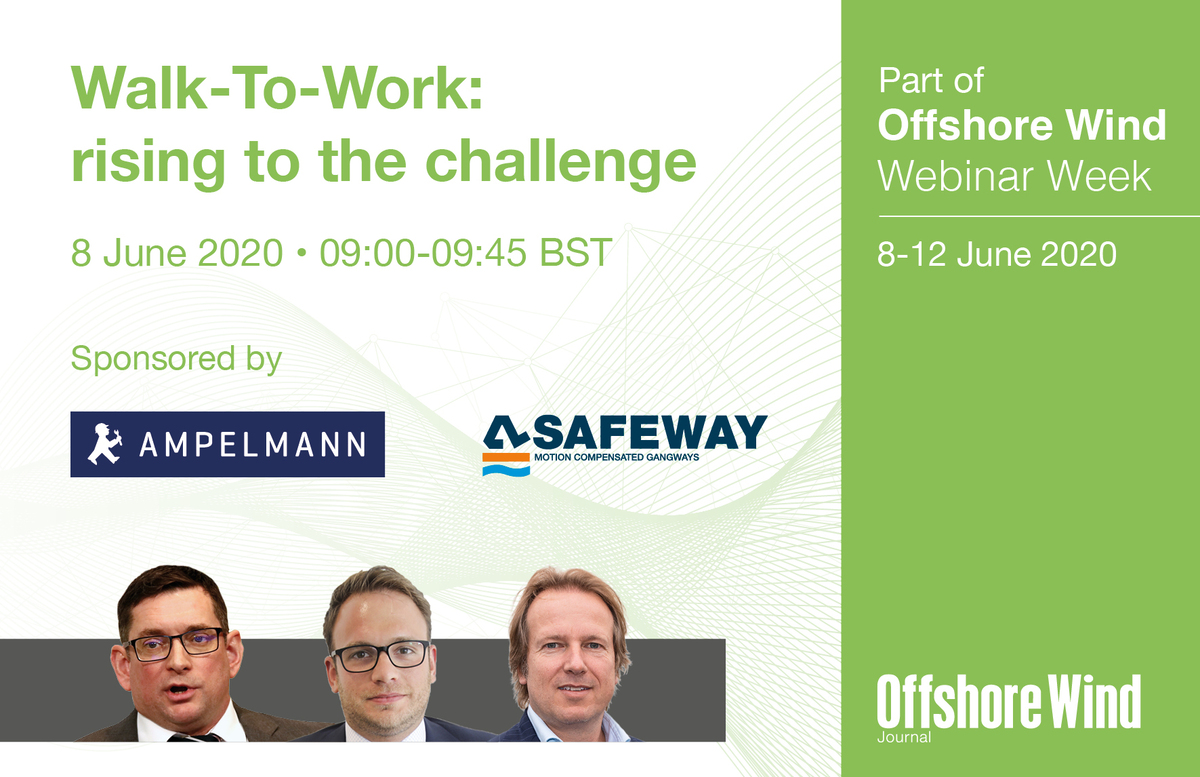
In Riviera Maritime Media’s ‘Walk-To-Work: rising to the challenge,’ webinar, panellists were uniform in their views about a number of subjects, but one thing stood out: that data can drive the development of more efficient, safer access to and from offshore wind turbines


The webinar was the first in Riviera Maritime Media’s Offshore Wind Webinar Week, part of an ongoing series of webinars.
Bibby Marine Service chief executive Stephen Bolton, Ampelmann business development manager Caspar Blum and Safeway BV chief executive Wijnand van Aalst were in agreement that, as the walk-to-work market for offshore wind grows and goes global, the more the industry collects and makes use of data, the more efficient it will become and the safer connections will be.
The end result will be that data helps the walk-to-work market drive down costs and enhance windfarm operations and maintenance. In turn, that will help to further reduce the levelised cost of energy of offshore wind.
Mr Bolton highlighted Bibby Marine Services’ use of a digital twin of its vessels that enables the company to predict access on specific projects in specific conditions. He explained that this allows the company to have a conversation with clients about the percentage of operating time a vessel – and an access system – will be able to actually provide access to a turbine.
Mr Bolton said that collecting data on a regular basis, analysing it and providing feedback enables key personnel such as a vessel’s master and dynamic positioning officer to further enhance their skills.
In the longer term, said Mr Bolton, data could help the industry enhance operating practices and enable technicians to be safely be transferred to turbines in higher sea states than current practice allows.
As highlighted previously by OWJ, contracts for walk-to-work vessels in the offshore wind industry are usually defined in terms of access at a significant wave height (Hs), within which transfers must be capable of being undertaken. But Mr Bolton believes focusing purely on Hs could place unnecessary limits on the ability of a vessel to undertake transfers and that well-designed ships with suitable access systems can do better than industry norms suggest.
Mr Blum told delegates Ampelmann sees three key changes taking place in the offshore wind walk-to-work market. The first is the ever-growing size of turbines to which walk-to-work systems must provide access; the second is the need to make access systems ‘greener,’ with reduced power demand and the introduction of electrically powered systems. The third, he said, is the need to enhance efficiency by using purpose-built vessels, integrated walk-to-work systems and ‘data-driven operations.’
Mr van Aalst told delegates Safeway also sees data analytics as an important tool for cost reduction, both prior to a job and ‘on the job’. The company uses hardware in the loop and wave simulation techniques during production; while on the job, it uses remote access, a daily ‘digital handshake,’ KPIs and artificial intelligence to enhance operations and plan maintenance work.
You can view the webinar, in full, in our webinar library.
And you can sign up to attend one of our many upcoming webinars on our events page.
Polling of delegates attending the event also provided some interesting insight into trends in the market. Asked about future requirements for walk-to-work vessels in the offshore wind industry, the need for higher levels of workability was clearly perceived to be the most important development.
Asked about what the maximum significant wave height (Hs) for transfers in the offshore wind industry could be, only 6% of respondents believed that 2.5 m Hs – the current industry norm – was the true limit for transfers. Approximately half of those who believe 2.5 m can be bettered think 3.0 m is do-able, and around 50% see 3.5 m as a better estimate of the limit for safe transfers.
Interestingly, with the second webinar in Riviera Maritime Media’s Offshore Wind Webinar Week – ’Green vessels for a green industry: the offshore wind sector’s race to decarbonise its assets’, which takes place 10 June, 09.00-09.45 BST looking at this very issue – more than 63% of those polled said vessel owners that do not take account of the need to provide the industry with green vessels risked being left with ‘stranded assets’ that would struggle to find work in future.
Full poll results:
Maintaining high safety standards
57.14%
9.84%


Related to this Story


Events

Passenger Shipping Webinar Week
 21 Sep 2020
 BST
BST
Marine Propulsion Webinar Week
29 Sep 2020BST
Maritime Air Pollution, Europe
20 Oct 2020CET
Maritime Hydrogen & Fuel Cells, Europe
26 Oct 2020BST
Quick Links
London Office
Riviera Maritime Media Ltd,Mitre House, 66 Abbey Road,
Enfield EN1 2QN, UK
Phone: +44 20 8364 1551
Email: [email protected]
Singapore Office
Riviera Maritime Media Singapore Pte Ltd,1 Fusionopolis Place, 03-20, Galaxis,
Singapore 138522
Phone: +65 6809 1278
Email: [email protected]


