

Contents

Publications


Publications

Contents
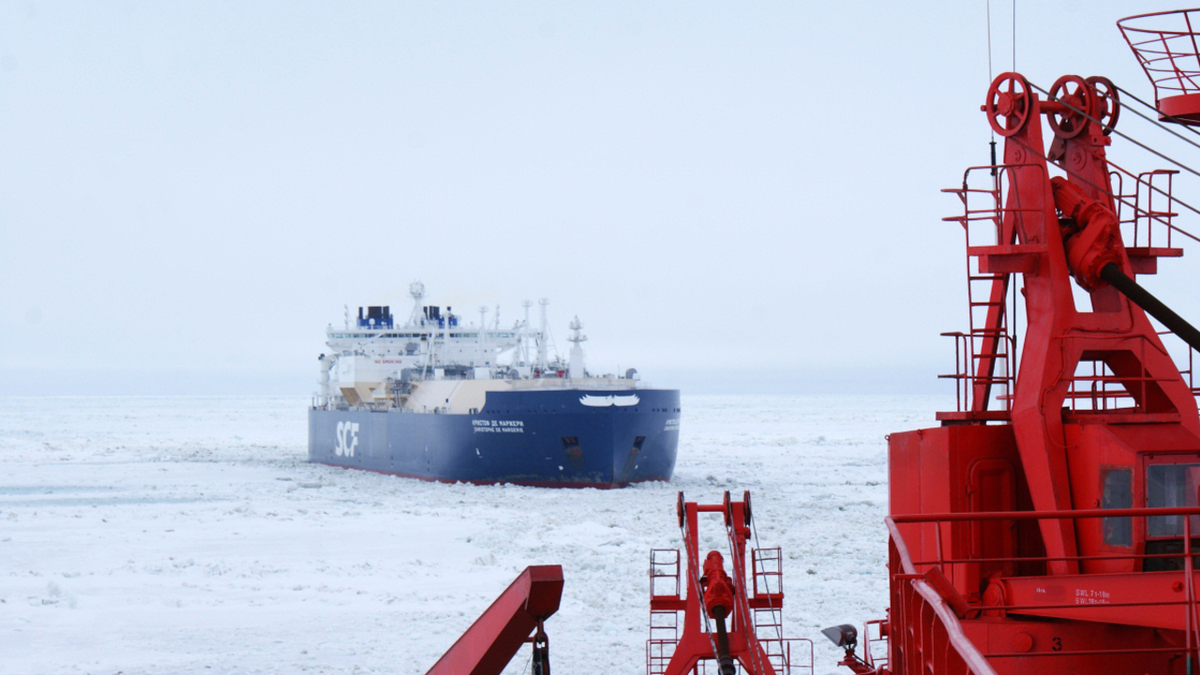
Eastbound voyage across NSR opens opportunities for Russian LNG
In an historic eastbound crossing, Sovcomflot’s ice-class Arc7 LNG carrier Christophe de Margerie has completed its passage across the ice-infested Northern Sea Route (NSR) in May, bound for China with a cargo of LNG from Russia’s Yamal LNG project


The voyage represents the first time a large-capacity LNG carrier has crossed the NSR eastbound in May, when ice conditions remain challenging. Traditionally, the navigation in this sector only commences in July.
The passage from the Port of Sabetta to Cape Dezhnev took the vessel 12 days to complete, during which the LNGC covered 2,563 nautical miles at a speed deemed safe given the navigational conditions.
While on the NSR, 172,600-m3 Christophe de Margerie was escorted by Atomflot’s nuclear-powered icebreaker Yamal. The LNGC transited the most challenging parts of the route with Yamal’s support, including fast-ice fields in the Vilkitsky Strait, as well as hummocky ice floes in the East Siberian and the Chukchi seas.
Sovcomflot (SCF) owns Christophe de Margerie and has five other Yamalmax LNG carriers, Hulls 041 to 045, on order at Russia’s Zvezda Shipyard for delivery in 2023.
“Over many years, SCF has been undertaking increasingly challenging transportation projects in the Arctic seas, in partnership with Atomflot, Russian energy companies, and R&D institutions,” said Sovcomflot chairman of the board Sergey Frank. He said the company’s accumulated unique experience of safely operating large-capacity vessels of high ice class laid the groundwork for the voyage. “Thorough preparation has allowed us to make the next step and safely carry out this unique voyage, fully in line with SCF’s core principle ‘Safety Comes First.’”
Sovcomflot president and chief executive Igor Tonkovidov, commented “This successful voyage across the NSR in May allows us to move one step closer to realising the full transit potential of the Northern Sea Route, marking an important expansion in the shipping opportunities available to Arctic industrial projects in particular.” Added Mr Tonkovidov, “Even in the challenging ice conditions encountered this time of the year, choosing the NSR allows for a significant reduction in the length of a voyage delivering LNG to APAC ports compared with using the Suez Canal. A shorter voyage both allows us to optimise logistics and reduce the carbon footprint of the shipping.”
Continued Mr Tonkovidov, “What’s more, the vessel that began this new era in Arctic shipping both carries LNG, the cleanest fuel currently available, and uses LNG fuel itself, which drastically reduces the vessel’s impact on the environment.”
Christophe de Margerie master Sergey Gen commented “The ice conditions encountered during the voyage matched our forecast: on some segments, the movement was heavily obstructed, but the crew was well prepared to handle it.”
The voyage has provided extensive information about the ice conditions along the eastern part of the NSR. This will prove valuable for planning transportation solutions for future energy projects in the Arctic and could help expedite the future growth of NSR cargo traffic. This information will also be reflected in the design of future generations of Arctic vessels, said SCF.
Riviera will host a week of free to attend 45-minute webinars focused on gas carrier tankers and terminals commencing 15 June. Register your interest now


Related to this Story


Events

Maritime Communications Webinar Week
 20 Jul 2020
 Online
Maritime Hybrid, Electric and Fuel Cells Webinar Week
27 Jul 2020ONLINE
Maritime Cyber Security Webinar Week
04 Aug 2020ONLINE
Offshore Webinar Week
11 Aug 2020ONLINE
Quick Links
London Office
Riviera Maritime Media Ltd,Mitre House, 66 Abbey Road,
Enfield EN1 2QN, UK
Phone: +44 20 8364 1551
Email: [email protected]
Singapore Office
Riviera Maritime Media Singapore Pte Ltd,1 Fusionopolis Place, 03-20, Galaxis,
Singapore 138522
Phone: +65 6809 1278
Email: [email protected]


