

Contents

Publications


Publications

Contents
Ballast water treatment: alternatives to onboard systems
Finding space in OSVs to fit a BWTS can be a challenge, but alternatives exist which can also form part of a contingency plan if the onboard system fails


Do OSVs require ballast water treatment systems? It is a frequently asked question, especially where the vessel only operates in the same area. While offshore vessels are unlikely to discharge as much ballast water, or as often, as deep-sea commercial ships, they are still required to comply with the regulatory requirements. Choice Ballast Solutions senior compliance engineer Debra DiCianna says there are few exceptions to the Ballast Water Management Convention (BWM) and it is always best to seek advice from an expert in compliance.
“As per regulation E-2 of the BWM Convention, the government of the coastal State (for floating platforms, FSUs and FPSOs) or the flag administration (for vessels below 400GT) will determine whether or not the vessel must comply with D1 (exchange) or D2 (treatment) regulations,” says Ms DiCianna. “However, as per BWM.2/Circ.46, Mobile Offshore Units of 400 GT or above should comply with the provisions of the Convention and should be surveyed and issued with an International Ballast Water Management certificate. If they are reasonably permanently positioned, it may be asked of the Administration (Shelf State) if the BWMP or Record Book is required. The Flag Administration will determine the D2 compliance date for vessels that do not have an IOPP certificate. Ships without an IOPP have until September 8, 2024 to comply,” she explains.
“Manufacturers have had very little motivation to adapt their systems for use on OSVs”
Operators are mostly aware that a BWMS is a requirement, but some may be confused by the varying compliance regulations for floating platforms, FSUs and FPSOs, or their compliance dates when the vessel does not have an IOPP certificate. Further, an OSV’s operational area can vary, meaning in some cases the vessel may need to treat ballast water and on other routes it will stay within a body of water and will not need to treat it. Under USCG regulations, offshore vessels that operate within one COTP zone are not required to comply with the discharge criteria; however, they still must comply with the reporting criteria. Internationally, OSVs could be exempt if traveling only between specified ports or locations within the same risk area. These exemptions may be given under the jurisdiction of local authorities, but testing for same risk areas can be very expensive and approval lasts for a maximum of five years at a time.
The OSV owner/operator would be wise to seek out a ballast water treatment system (BWTS) from a supplier that has contracts within the OSV community, and to use an engineering company with experience of OSV installations. For many ballast water management system (BWMS) manufacturers, the offshore sector is not a target market, due to the size of such vessels, limited installation space, and/or retrofit costs. Ms DiCianna says: “With all the complexities and engineering challenges associated with offshore vessel compliance, manufacturers have had very little motivation to adapt their systems for use on OSVs. This limits the options we have been able to offer in our feasibility studies that are ‘fit for purpose’ to the offshore sector.”
Honesty and respect
And given current concerns on the back of international Covid-19-related lockdowns, there is added value in using an OEM supplier with a robust logistics supply chain and an engineering company that has experience of retrofit installations during these troubled times. The president of the Ballast Water Equipment Manufacturers Association (BEMA) and senior market manager, Hyde Marine, Mark Riggio says: “We have seen a manufacturing hub for ballast filters impacted. Manufacturers across the globe are finding new ways to produce systems, but with less efficiency and speed than before. Now more than ever we need to band together as an industry to meet the challenges that we all face. We need to look our customers in the eye and speak from a place of honesty and respect for each other.”
“One onshore system servicing several vessels, no dry-docking costs and no off-charter losses”
Owners and operators must also act with responsibility: it is critical to engage an experienced engineering firm 18 – 24 months before the IOPP date to start looking at retrofit options. An alternative to the onboard treatment of ballast water in the US involves using municipal fresh water and/or municipal waste-water treatment. But this is largely theoretical: “There are no onshore treatment facilities in the US,” said Ms DiCianna. Other alternatives include the use of mobile systems such as Damen’s InvaSave system or shore- or barge-based containerised systems.
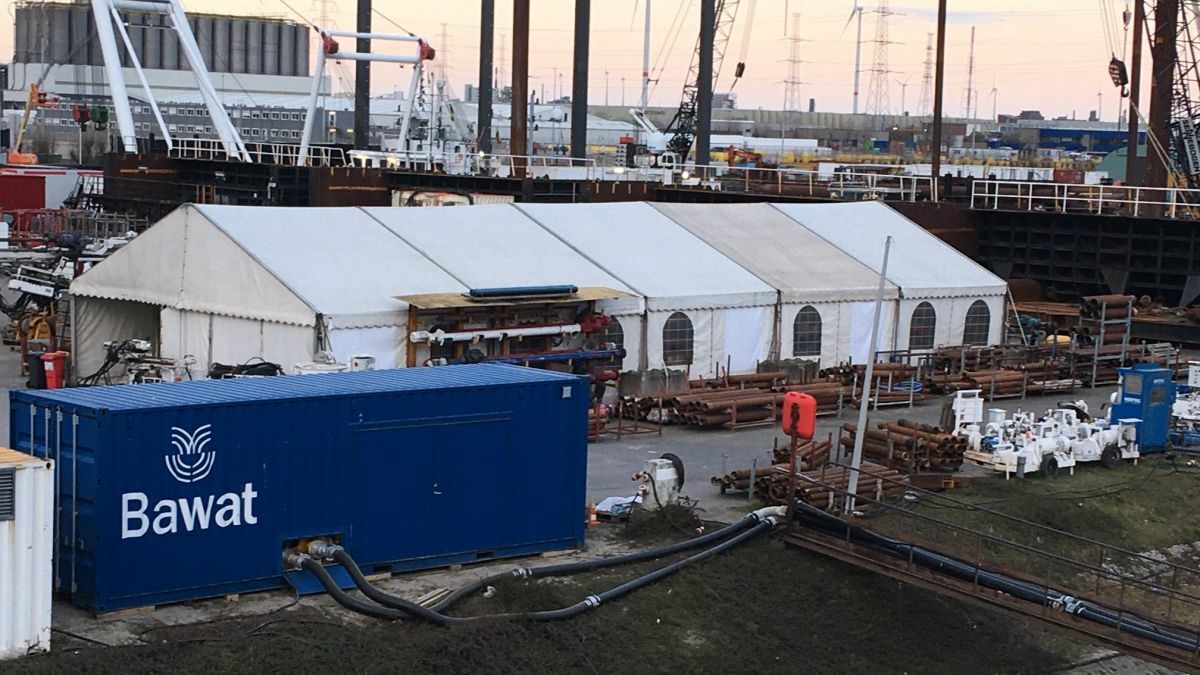
“For PSV/OSV operators whose vessels always call at the same ports, there are large economic and operational advantages with a shore-based solution,” says Danish ballast water treatment supplier Bawat’s chief executive officer Marcus Hummer. “OSV/PSV ballast patterns are such that de-ballasting in almost all cases takes place in the same ports, and thus having a shore-based ballast water treatment facility allows operators to service multiple ships with one treatment plant,” he says.
According to industry sources, a North Sea-based operator is looking to install a shore-based plant in its major ports in Scandinavia and the UK, enabling it to service its entire North Sea fleet from three or four onshore installations. “The plants are containerised and mobile, so should the trade pattern of the OSV/PSV operator change, the treatment plant can be moved as well,” says Mr Hummer.
The economics of the set-up are attractive: one onshore system servicing several vessels, no dry-docking installation costs and no off-charter losses. Minimal retrofit work on the vessels to allow easy connection to the port-based treatment system is a small price to pay in comparison to installing a treatment system on each vessel.
Of those treatment systems that can be utilised in port, the Bawat containerised system uses pasteurisation technology, while Damen InvaSave employs UV technology. Unlike the majority of vessel systems, both only require a single stage of treatment. Neither system requires chemicals and the Bawat system also does away with a filter, avoiding the costs associated with waste disposal.
Access to a port-based system may prove difficult if the system is located on the quayside of a busy port. A solution to this involves mounting a containerised system on a workboat or barge, which can manoeuvre around the port and bring the treatment to the vessel.
Such systems can be used in the US, as shore-side containerised BWTS do not have to be approved by the USCG. Once the ballast water leaves the ship, it is classed as waste-water and subject to local port and jurisdiction rules.
This is the main thrust of the portable system being developed by Glostens, which is developing the oneTank system. Glostens director of research and development Kevin J. Reynolds has been at the forefront of testing the system on several vessels in the US and explains that when oneTank is used on board a ship it is under control of the Master and the ship remains liable for the operation. The oneTank system is reaching the final stages of development and is expected to be launched shortly.


Related to this Story


Events

Maritime Communications Webinar Week
 20 Jul 2020
 Online
Maritime Hybrid, Electric and Fuel Cells Webinar Week
27 Jul 2020ONLINE
Maritime Cyber Security Webinar Week
04 Aug 2020ONLINE
Offshore Webinar Week
11 Aug 2020ONLINE
Quick Links
London Office
Riviera Maritime Media Ltd,Mitre House, 66 Abbey Road,
Enfield EN1 2QN, UK
Phone: +44 20 8364 1551
Email: [email protected]
Singapore Office
Riviera Maritime Media Singapore Pte Ltd,1 Fusionopolis Place, 03-20, Galaxis,
Singapore 138522
Phone: +65 6809 1278
Email: [email protected]


