

Contents

Publications


Publications

Contents
Condition monitoring boosts lifesaving equipment maintenance
Condition monitoring, predictability and fixed prices are increasingly important for maintaining passenger ship lifesaving equipment


The launch of LifeCraft this year opens up a very different maintenance programme for operators who choose this system, due to the hybrid system’s unique features.
Its features mean that, as Viking Life-Saving Equipment senior vice president passenger division Niels Fraende says, its maintenance schedule will be “much more predictable”.
As it is stored in a container, conditions are controlled. Mr Fraende says “Conditions like salt content and humidity are controlled, and the level of humidity is kept underneath corrosion level. In that way we are getting a system that is safer and not the same as other types of equipment such as davits and lifeboats that are exposed to the environment.
LifeCraft: predictable maintenance
“Maintenance will be a lot more predictable, and it will have a more structural element to its maintenance as the weather conditions do not have such an influence on the equipment. Controlling the elements in which they are stored makes the equipment much more reliable.”
LifeCraft can be electronically surveyed daily, with information sent directly to the bridge. “The bridge then has an overview of readiness and a live awareness of the LifeCraft System’s condition,” says Mr Fraende.
Elsewhere, Viking has a wide ranging and robust maintenance programme. Mr Fraende elaborates. “It is a scheme that knows exactly what needs to be done every year in a 10-year cycle. Certain years are more important than others – typical five and 10-year maintenance can be combined with the docking schedule of a vessel. This reduces inconvenience and disturbance in the daily operation for the operator.”
Viking has annual meetings to plan lifesaving equipment maintenance routines.
Mr Fraende adds “We have a fleet of more than 1,500 MES systems worldwide and have registered what has happened over the years. By doing things more systematically, we are gathering ever-more experience and data in how they are performing.”
He gives an example. “If we have an element that in theory is good for three years, but replaced after two years, we are making sure it is extremely reliable.”
He highlights the need for cruise ships to have a structured maintenance programme as they sail all over the world, experiencing different weather, humidity and salt content depending upon location.
Emphasis on fixed price
Meanwhile, Lifesaving Systems Australia (LSA) has a slightly different maintenance set-up compared to other life-saving appliance companies. LSA European manager Peter Rea says “We are differently set up as we do not own any of our service stations or network. We have a trusted network of independent service agents in over 30 countries, strictly trained by us.”
Pointing out the benefits he says, “Most of the service stations are owned by families or by sole individuals who work in servicing themselves.” He highlights the benefits of the business owner dealing directly with the customer and handling the product daily, leading to high standards of service. He adds “The shipowner increasingly wants certainty, in terms of fixed price for service and maintenance and they are being more particular in asking service stations for fixed prices.
“We encourage service stations in this and say, ‘be as upfront as possible and do not hide costs, make it simple to read and interpret the quotation’.”
As a part of this theme, he emphasises the company’s collaborative approach to ferry projects.
“It is not just focusing on the capital costs of shipyards but focusing on the shipowner and getting them to look at the long-term costs of ownership,” he says. The company looks at the long-term cost of ownership and ensures their customers have a known cost every year.
Mr Rea adds “Equipment coming to the end of its serviceable life does not need to be replaced in one go, components of an MES can be replaced one at a time, so it is not a huge change and cost and is easy to budget for. We work closely with owners and service stations, making sure they know well in advance that they are looking at replacement in one to five years, so they can budget for that.”
He added “We are open and honest and do not give any surprises.”
He highlights that although LSA has no financial interest in service, “we like to keep an involvement – we have a hard-earned reputation for quality, reliability, honesty and transparency and want to maintain that”.
The theme of long-term maintenance service agreements is a strong trend within the cruise sector. Survitec global technical sales Malcolm Barrett says “While there will always be a spot market for liferaft servicing, particularly where vessel owners operate specific routes or trades are seasonal, such as ferries, we see a general global trend for long-term liferaft service arrangements, particularly among our cruise ship owning customers. This is because cruise ships have a higher number of liferafts, operate all-year round and have greater operational expenditure than other types of passenger vessels.”
Extended Service Raft boost
He says that since the introduction of IMO MSC.1/Circ.1328, the company has noticed an increase in orders for its Extended Service Raft concept, which allows liferafts to be serviced every 30 months, rather than the 12 months under the servicing model required by SOLAS up until 2009.
He adds “To meet the MSC.1/Circ.1328 requirement, we pioneered the Extended Service Raft concept in 2012 with the launch of a raft hermetically sealed in a water-tight silver foil bag inside the container. This ensures the correct humidity and CO2 level – a key requirement of the regulation and vital to raft reliability, operability and deployment – is maintained. We also incorporated sensors so crews can take humidity and CO2 readings directly from a USB port on the side of the container using a handheld device.
“While others have followed suit, with competing extended service rafts, the monitors’ batteries are in the container, which means when they need replacing the entire system has to be sent to a service station. As a consequence, some manufacturers recommend readings be taken at monthly intervals to preserve battery life.”
With a Survitec ESR, batteries are in the handheld device so condition monitoring data can be uploaded daily if needed.
He explains “In time this condition monitoring and inspection data could be input to a centralised portal and accessed by mobile phones or tablets, so that surveyors, crew members and service providers can have a much greater picture of the condition of liferafts across entire fleets. Adopting ESR allows you to monitor the condition of the liferaft in real-time.”
LifeCraft – cleared for installation on ships
The company has announced the first flag state approval of its entire Viking LifeCraft system, meaning the world-first inflatable and electrically powered evacuation solution is now cleared for installation on ships around the world.
The stamp of approval was issued by the Danish Maritime Authority on 23 August 2019. This follows the earlier approval of key components of the system, such as the Survival Craft, as part of the system’s development journey.
The Viking solution has been approved as a novel life-saving appliance system – a well understood and accepted category in the maritime industry. The novel life-saving appliance designation reflects the dual nature of the VIKING LifeCraft system, which makes it possible to replace current lifeboat and liferaft evacuation options with a superior, hybrid solution.
“Everyone in the industry knows that novel life-saving equipment requires strict alternative design studies and documentation that can show their superiority to existing life-saving appliances,” says Viking vice president of sales cruise and LifeCraft Niels Fraende. “We’ve certainly gone the distance with the new system, setting new standards for our design and testing activities throughout the process.”
He tells Passenger Ship Technology, “We have had high interest from the whole industry from shipyards to shipowners. We were working on it publicly, so the maritime community was aware this development was coming. For those of us who have been working on this project for 10 years, it has been wonderful to see it materialise. It makes the industry more exciting because it is something new and changes everything.”
He adds that LifeCraft has won several awards, including a Seatrade award and one from Safety At Sea. “This recognises we have something different that will be a real gamechanger,” says Mr Fraende.
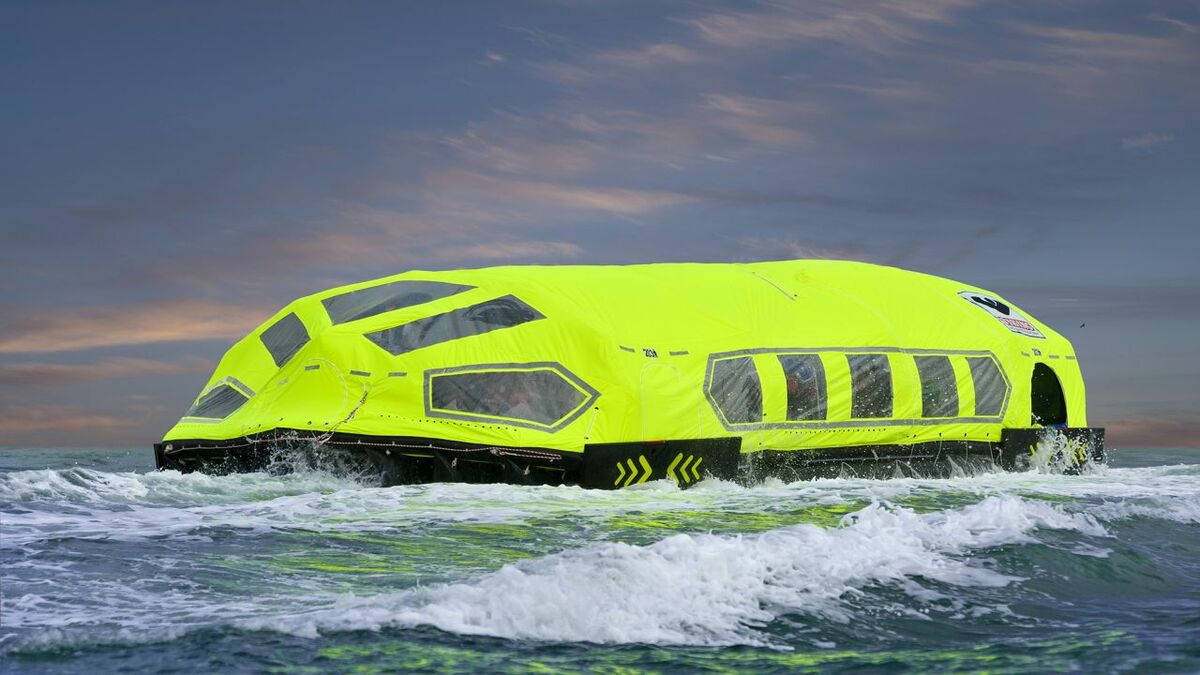
The LifeCraft system has capacity to save 812 people and consists of two main elements: inflatable survival crafts, and a self-contained stowage and launching appliance that can either be placed on deck or built into the ship’s side.
Every system is equipped with four survival crafts able to hold 203 people each. With four independent electric engines at its corners, Viking says each survival craft is highly manoeuvrable and its ability to quickly turn 360° is unmatched by conventional motor-propelled survival crafts.
“We expected the final approval process to go every bit as smoothly as the previous novel life-saving approval, and it did,” says Viking chief executive Henrik Uhd Christensen. “And this achievement comes at a perfect time, considering the amount of interest cruise shipowners are showing in getting this new evacuation solution installed and operational. Now they can take their plans for incorporating Viking LifeCraft into both newbuilds and existing ships to the next level.”


Related to this Story


Events

Marine Lubricants Webinar Week
 14 Jul 2020
 ONLINE
Maritime Communications Webinar Week
20 Jul 2020Online
Maritime Hybrid, Electric and Fuel Cells Webinar Week
27 Jul 2020ONLINE
Maritime Cyber Security Webinar Week
04 Aug 2020ONLINE
Quick Links
London Office
Riviera Maritime Media Ltd,Mitre House, 66 Abbey Road,
Enfield EN1 2QN, UK
Phone: +44 20 8364 1551
Email: [email protected]
Singapore Office
Riviera Maritime Media Singapore Pte Ltd,1 Fusionopolis Place, 03-20, Galaxis,
Singapore 138522
Phone: +65 6809 1278
Email: [email protected]


